.jpg)
After taking the measure of Goma (and several hot showers), LB and Ghassy bundled me into our trusty (when not requiring a jump-start) four wheel drive and headed for the hills.
One of the projects their organisation is undertaking is to build a block of toilets for around 420 students in a remote school in Nyamitaba, North Kivu. What's so hard about that? Well, let me put this into context. A car in the UK, on good roads, can easily cover sixty miles an hour. Most people, foot down, manage eighty on a motorway, legal or otherwise.
It took us six hours to travel 75 miles. Six hours.
That's how bad the roads are. But at least the scenery was pretty.
Scratch that, it was stunning. Congo does not disappoint. It's one of the most breathtaking places I've seen. Like Rwanda, but on a grand scale. Coming from Rwanda, where every inch of earth is cultivated, it's quite something to see large sprawling spaces with no apparent farms, then to look up and see almost vertical fields ploughed down the side of mountains.


We drove north through the countryside for an hour or so until we hit Sake. That's when things got a little hairy. This is where ignorance can sometimes be bliss. I later heard that Sake is one of the first places government troops lose control when fighting flares up. It's a crazy town. People everywhere. Mud, garbage, animals and naked children.
Soon, we came to two police officers in yellow jackets who seemed to be waving us down. For me, living in Rwanda, when I see traffic police, my automatic reaction is to stop. Why wouldn't you? Okay, they can be a bit overzealous, ticketing people for 31 in a 30 zone, but on the whole they're just doing their job.
Imagine my surprise when LB hits the gas!
"Err... I think they were waving us to stop," I tell him.
"This is Congo. You stop, you stop for trouble."
He veers off a side road, bumping along the potholes, until we reach a road block.
Dumb mzungu, I'm thinking What is this? A border crossing?
No. Random rebels just set up road blocks anywhere they fancy and charge people to cross.
Only, the guy wasn't going to let us pass. LB tries to reason with them. Eventually, he finds a sympathetic ear and greases a couple of palms.
As the block is being removed, a moto pulls up and the two police officers dismount. One even salutes, military-style.
Just as they're approaching our window, the barrier opens. LB slams down on the gas and we go flying through as the police scream at the men to close the gate!
I just grip onto the dashboard with all my might as we start swerving our way up the mountain road, higher and higher into the jungle, tailing a van in front.
I take my mind off what the hell just happened by staring out of the window. The view is heartbreakingly beautiful and all you keep thinking is 'If only it was peaceful here... If only.'


 |
| Nyiragongo |


It was all going well until we ran into a lorry which was stuck in the mud. Whilst they were digging it out, the guys (LB, Ghassy and the two others who were with us) got out to stretch their legs, and that's when LB realised he knew the man in the car we'd been tailing. Yes... the man who got out of the car, with an armed guard of four soldiers!
Apparently he's a local ministerial official. He and LB have known each other for years. When we finally got on the road again I smiled and said how nice it was to know there was an armed escort just ahead of us. LB apologised and said that his cousin, who works in the military, had offered him an armed guard for the trip but he'd declined.
"If you have a gun in the car, the first thing anyone's going to do is shoot at you."
I saw the sense in that. If we had one gun and they had more than one gun - we'd lose. If we had no gun, we'd stand half a chance of reasoning our way out of it.
"Guys with guns are like snakes," he said. "They shoot when they feel threatened."


Meanwhile, out the window... this is apparently a rebel village Laurent Nkunda built! Apparently it's largely been abandoned since then.
Along crazy roads and through the jungle we went (well, it was a jungle until Kabila cut down all the trees to graze cattle). Eventually arriving in the town of Nyakariba.

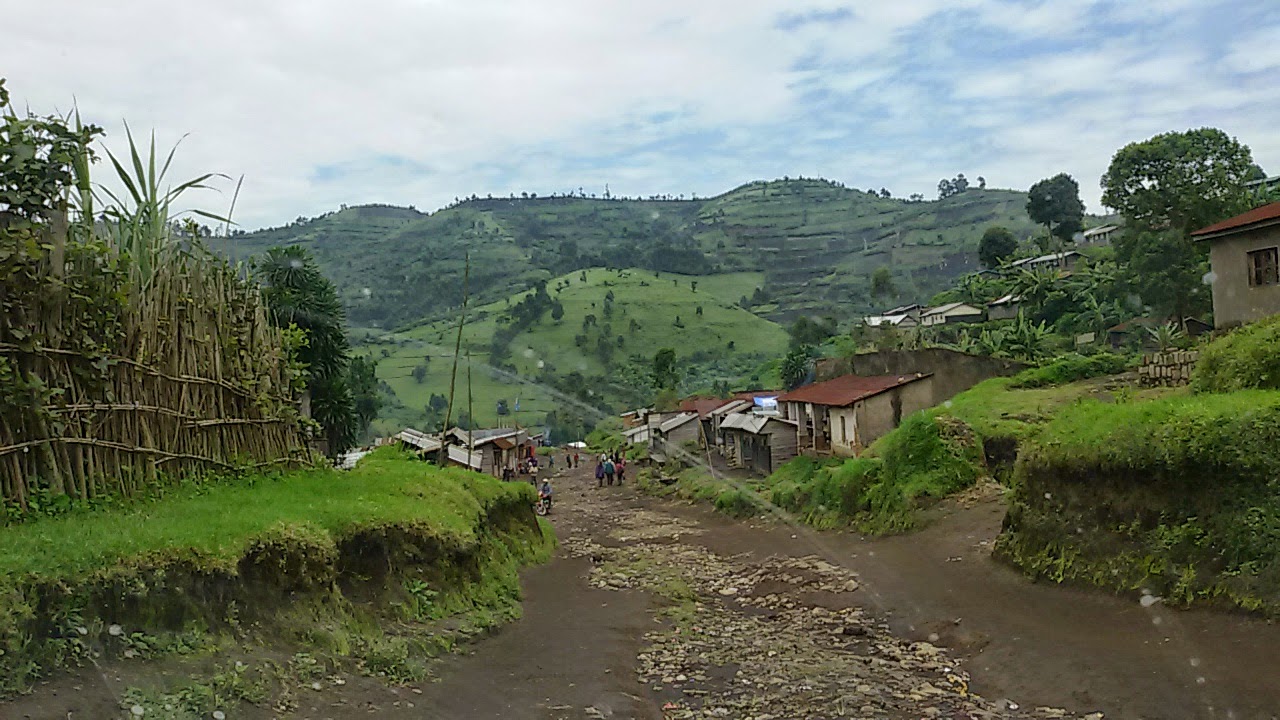

See that little pile of rubble in the river bend? Yeah, that was the bridge. So we ditched the car and started walking about a mile up the road to the small village of Nyamitaba. This is where the school is.
 |
| (panoramic, click to enlarge) |


 |
| Student. |

 |
| Head Teacher's Office |
 |
| Library. |
The school has a few problems. Namely maintenance, and the fact rebels tried to burn it down last time they passed through. Big, hard men that they are. Takes a lot of guts to burn down a school. Really makes a political statement and wins people round to your cause.


Then we come to the toilets. These ones were built by Spanish missionaries - for Spanish missionaries - probably some time in the sixties. They don't work anymore.


However, these ones were built by World Vision...


Can you guess how old they are?
Three years.
Built out of wood in the middle of a humid jungle... they rotted.
Where's the vision in World Vision, again?
420 kids with nowhere to go to the toilet.
LB's organisation has just managed to secure funding to build a proper, concrete toilet block, and we're looking into eco-toilet options. Something that might produce compost for the food they grow.

 |
| Surveying the Land |
 |
| Lesson in Tying Ties |
 |
| Cheese! |
After that it was time for tea at the vicarage. LB is actually a Catholic priest for a London diocese, but he's a self admitted 'rebel priest' - all the spiritual without the dogma. As such, he gets welcomed just about anywhere with a cross on the wall. We were all extremely grateful for this when the new priest of the area (very new, three weeks - since the last priest ran off with all the cash and a dozen tins of paint...) invited us to lunch. We hadn't eaten anything since setting off from Goma at 5:30 that morning. The roads are so bad it's a struggle to keep food down. When we arrived, he offered us milk and ikivuguto (natural yogurt) to tide us over, then had a full spread ready for our return.


Potatoes, beans, sombe (mashed cassava leaves), ugali (cassava bread) and chicken. After scrubbing well, it was time to get hands-on with our food. All except the priest, who used a knife and fork. Happy savages that we were, we opted for the fastest way of conveying food from plate to mouth.
The priest walked us back to our car. After the school toilets, there was talk of tackling the library, and the thinking is now to move the library to the parish. There is a spare room in the church with fairly constant electricity, and it's more secure from rebels than the school. It would also open the library up to local residents. Certainly something to consider.
One thing I really admire is that LB agreed to back this school because they have a good mix of female students. In the DRC, unlike Rwanda, school isn't free and it's much, much rarer for girls to get the opportunity for an education. I like the fact he's using potential project backing to encourage inclusivity and tackle discrimination.
 |
| Local kids who can't afford to go to school. |
 |
| A bridge of cows. |


 |
| Our trusty steed. |


 |
| Nyakariba |
As we headed for the hills, the storm clouds gathered.


And with the sun, the most incredible cloud I have ever seen. I took about twenty photos and none of them capture the colour of it. It was as though the top of the cloud was glowing with white light, a rainbow haze of purple, blue and gold radiated from it. I could have looked at it for hours. I've never seen a cloud like it in my life.


Then we got stuck behind these jokers on the way back down the mountain. They were drunk as lords, and refused to let us pass. Eventually Ghassy managed to sneak around them.


Then it was back to the chaos of Sake, just as it was getting dark. I was worried the police would remember the car and come after us again, but it seems roadblocks work like time-shares. The barrier we'd run earlier took quarter of an hour and several dollars to open. It's dreadful. If the guys on the gate decide not to let you pass, there's nothing you can do - there is no other road. They can basically ask whatever they want and there isn't any law enforcement to stop them - in fact, the law seem just as bad.
After we cleared that one, we got stopped at a new barrier just out of town. Again, men sitting around stoned, as one of our party observed.
We waited for ages, nobody moving. Then suddenly, this guy with a very big gun thrusts his head through our window. He was clearly upset about something and wanted to 'check' (ransack) our vehicle. LB spoke to him from the back seat and after a while he waved and opened the crossing.
"Do you know why they let us pass?" he asked. "I told him this was a holy vehicle. They believe in God. If you're a pastor, they let you go."
We talked about this later in the bar. LB said the policemen had scared him more. I disagreed. "The policeman," I observed, "saluted when he got off his motorbike. He was all balls and bluster. This guy - his eyes told me he really wanted to damage someone."
Personally, I wouldn't wish to test my theory as to which was the lesser evil that day. I'm just very grateful we got through the ordeal unscathed.
Well, near enough. We were within a few miles of Goma, driving along in the dark, navigating the potholes, when we came across a lorry by the side of the road. Just as we were passing it, something flew out of the night, straight through my open passenger window, and hit me smack in the face.
It stung, but I very quickly realised I was okay. What we think happened was that they were loading the lorry with gravel for the roads and just misjudged the thrust of their shovel. We were all coated in the stuff. Lesson learned - never leave your window open at night!
 |
| Sake. |


